
Otter Tail County Court Records After a Jail Arrest
After an arrest in Otter Tail County, jail booking creates custody information, but the court record begins with the case filed in Minnesota district court. The jail roster may show a booking charge and bond field, while Minnesota Court Records Online shows the case number, charge list, register of actions, hearing dates, court orders, and public documents when available. The two systems often refer to the same event, but neither one fully replaces the other.
The custody side is handled through jail inmate records, and booking-photo questions belong with jail roster mugshots. Court records after a jail arrest focus on what prosecutors file, what the judge orders at first appearance and later hearings, whether a warrant is active, and whether the case ends in conviction, dismissal, amendment, or another disposition.
First Appearance After an Otter Tail County Jail Arrest
The jail FAQ says an inmate has 48 hours to be seen by or have the arrest reviewed by a judge. Otter Tail County calls this the First Appearance Hearing. It is generally held at the courthouse at 11 a.m. on normal business working days. Whether the person appears the day after arrest or the next business day depends on case-specific factors that the county does not list publicly.
At first appearance, the judge may release the person, set bail or bond, impose release conditions, or continue detention. The roster can display bond information beside booking charges, but MCRO is the better place to confirm judge-entered orders, next hearing dates, and the formal court case status. The public may call the jail at 218-998-8556 before 11 a.m. to ask whether an inmate is going to court that day.
How to Find Court Records After an Arrest in Otter Tail County
Minnesota Court Records Online, or MCRO, is the statewide public portal for district trial court case searches. Otter Tail County District Court is part of the Seventh Judicial District and has original jurisdiction over criminal, traffic, civil, family, probate, juvenile, and conciliation matters filed in the county. Court Administration maintains court calendars, case records, fines, fees, trust funds, restitution, bail accounting, and trial exhibits.
Use the official Minnesota Court Records Online case search for public court case information after an arrest.
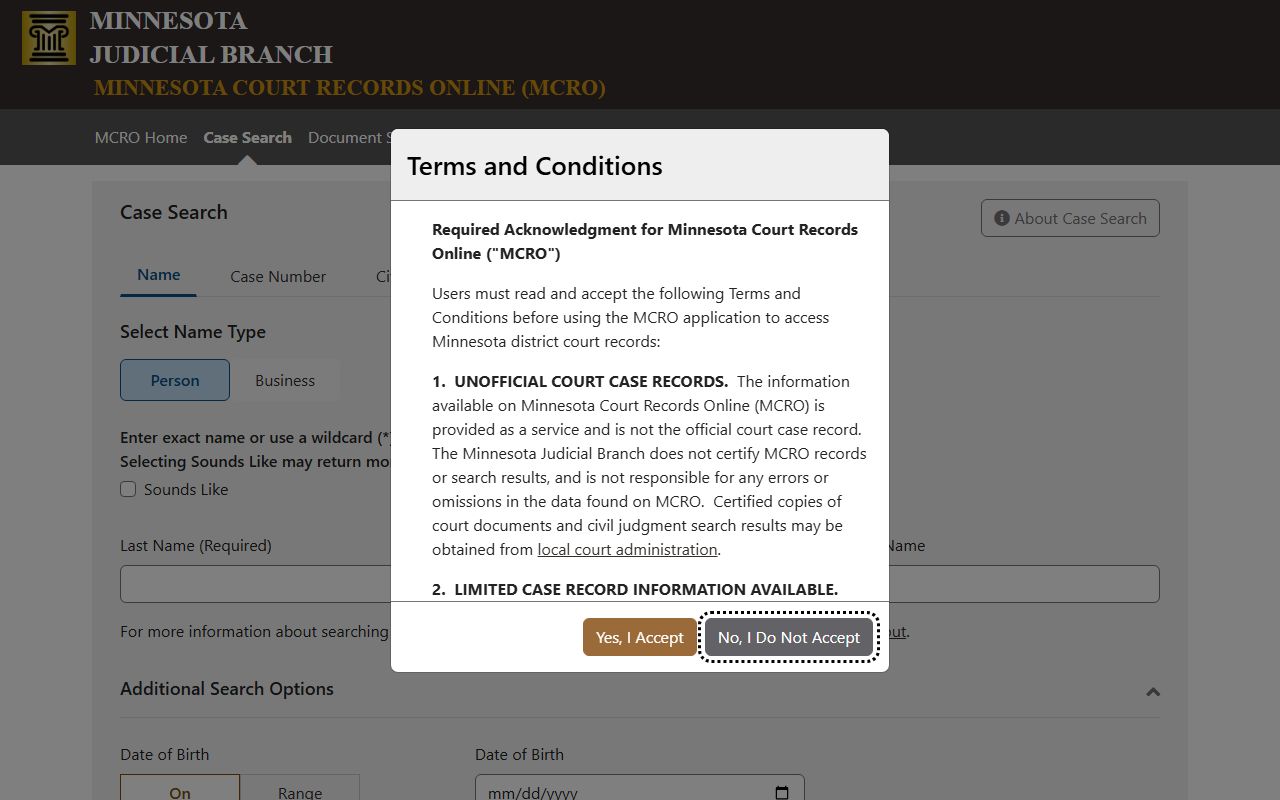
The county filter can narrow results to Otter Tail, but a statewide search may be useful when a person has cases in more than one Minnesota county.
- Open MCRO Case Search and review the terms because use of the portal is subject to MCRO terms and conditions.
- Select a search option such as name, case number, citation number, or attorney.
- Use the county selector to choose Otter Tail when the goal is a local case, or leave counties unselected for a statewide search.
- Open the matching case and review the register of actions, charge section, hearing list, and any public documents.
- Compare the court case against the jail roster if custody, bond, or warrant status is still active.
| Field / Control | Type | Required | Options / Format Notes |
|---|---|---|---|
| Search option | Tabs/options | Yes | Name, case number, citation number, or attorney search. |
| County selector | Multi-select/list | Optional filter | Includes Otter Tail; no county selection means the search is statewide. |
| Find | Button | Yes | Runs the selected search. |
| Clear | Button | No | Clears selected fields. |
| Clear Counties Selected | Button/link | No | Removes county filters. |
| Terms and Conditions | Acceptance notice | Yes by use | MCRO states use means the user has read and accepted its terms. |
Charging Documents After a Jail Arrest
Booking charges on a jail roster are not always the same as the final charges in court. After law enforcement books a person, the prosecutor reviews reports and decides what to file. In Otter Tail County, the County Attorney is the chief prosecutor for adult felony crimes and also prosecutes misdemeanor and gross misdemeanor offenses from unincorporated areas. City attorneys handle many incorporated-city misdemeanor matters.
| Document or record | Who uses it | What it does after arrest | Where to verify |
|---|---|---|---|
| Complaint | Prosecutor, often based on law-enforcement reports | Starts or supports the criminal case and states the alleged facts and charges. | MCRO public documents when available; Court Administration for access questions. |
| Citation | Law enforcement or prosecutor | Can begin traffic or lower-level criminal proceedings without a full custody booking in every case. | MCRO citation search and District Court records. |
| Warrant or bench warrant | Court and sheriff | Can lead to arrest, booking, and a new custody entry. | Sheriff warrant list, MCRO, jail phone line, and court confirmation. |
| Register of actions | Court system | Chronological docket of filings, hearings, orders, and dispositions. | MCRO case details for public entries. |
| Bond order | Judge or court | Sets release terms, bond amounts, or continued detention. | MCRO and direct jail or court confirmation. |
Charge Status in Court Records After an Arrest
Charge status can change after the first roster entry. A booking charge may be replaced by a prosecutor-filed charge, amended to a different count, reduced through plea negotiations, dismissed, or resolved by conviction. The jail roster is useful for immediate custody and bond display; MCRO is better for the case path from filing to disposition.
| Status | What It Means | Practical note |
|---|---|---|
| Active / Pending | The charge or case remains open and no final disposition has been entered. | Check hearing dates, bond orders, and warrants. |
| Amended | The charge text, count, statute, or level changed after filing. | Compare the original booking charge with the current court charge. |
| Reduced | The prosecution or court process moved the allegation to a lower level or different offense. | Often appears through amended charges or plea terms. |
| Dismissed | The charge was dropped by court order or prosecutorial action. | A dismissed charge is not a conviction, but public access may depend on later sealing or expungement. |
| Convicted / Sentenced | The person pleaded guilty or was found guilty and a sentence was imposed. | Sentenced prison custody may later appear in the MNDOC locator. |
| Warrant active | A court or law-enforcement warrant remains unresolved. | Confirm with the Sheriff, court, and MCRO because online lists are not complete substitutes. |
Bond and Release Orders After an Arrest
Otter Tail County's custody PDF can show bond amounts beside charges, including wording such as with conditions, without conditions, cash or bond with conditions, or file-specific amounts. At first appearance, the judge may release the person, set bail or bond, or keep the person in jail. A jail bond field is a public custody display; the court order is the authority for release terms.
| Bond or release item | How it works |
|---|---|
| Cash bond | Money posted directly under court or jail rules; confirm current acceptance rules before bringing funds. |
| Cash or bond with conditions | Roster wording can show money plus release conditions set by the court. |
| Conditional release | The judge sets rules such as appearance, conduct, or contact restrictions. |
| No-bond or hold situation | Release may be blocked by the court, another agency, a warrant, DOC, immigration, or U.S. Marshals status. |
The county does not publish a complete accepted-payment schedule for bail in the researched material. Commissary deposits through the jail kiosk or money orders are not the same as bond.
Warrants That Lead to a Jail Arrest
The Sheriff's Office publishes an Active Warrants List page and a linked PDF. The county says the warrant list updates daily and tells named people they may avoid additional expenses by reporting to the Otter Tail County Detention Facility or directly to court. People with information may contact the Sheriff's Office by email or use the Anonymous Tips option, and the county states identity will not be revealed.
A warrant arrest can lead to a new booking entry at the jail and then to court review. Still, a warrant page is not the same as a complete court record. Bench warrants, warrant returns, recall orders, and case-specific bond changes should be checked through MCRO and the court or jail when timing matters.
County Attorney and City Attorney Charging Roles
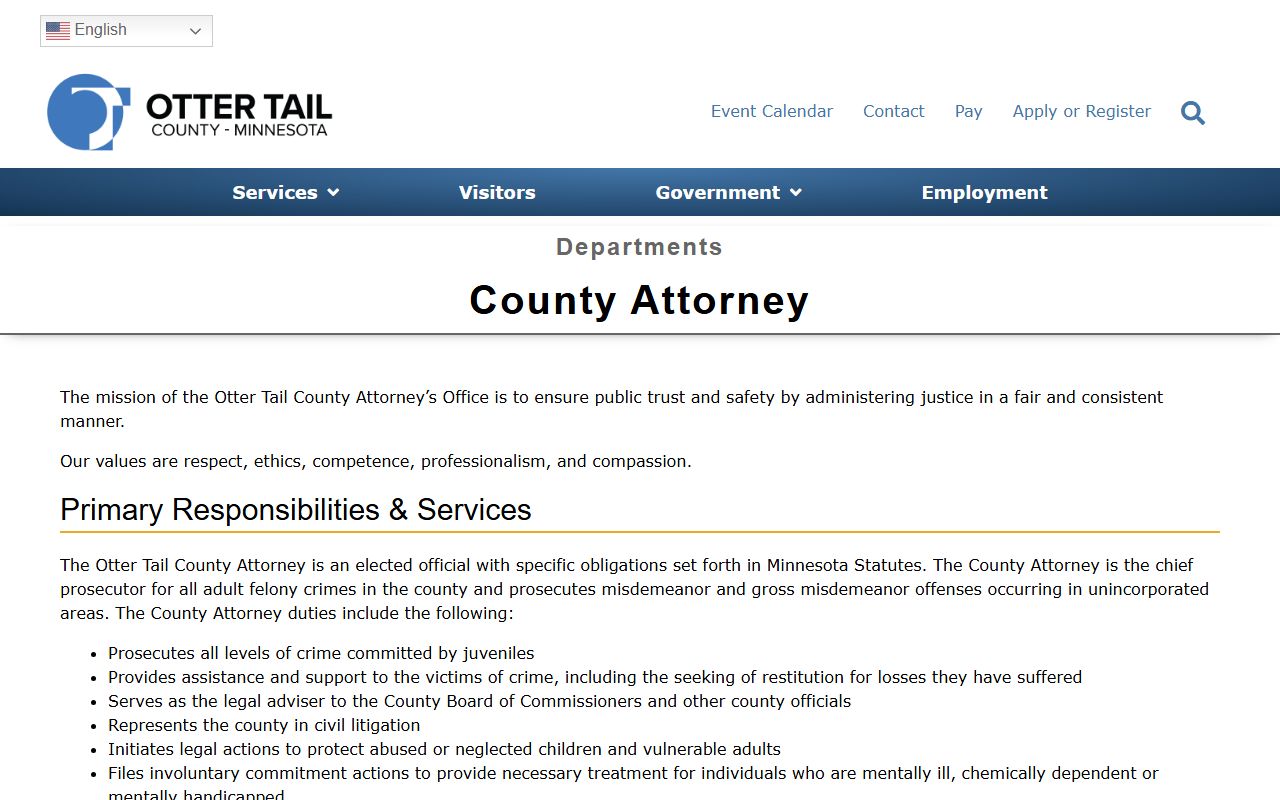
The Minnesota local title is County Attorney, not District Attorney. The Otter Tail County Attorney's Office is at 121 West Junius Avenue, 2nd Floor, Fergus Falls, MN 56537, and the official page names Michelle Eldien as County Attorney. The office is the chief prosecutor for all adult felony crimes in the county and prosecutes misdemeanor and gross misdemeanor offenses in unincorporated areas.
The official Otter Tail County Attorney page identifies the prosecutor's office, duties, and public contact point.
Incorporated-city matters may be assigned to city attorneys. County materials list city attorney contacts for Fergus Falls, Henning, Pelican Rapids, Parkers Prairie, Perham, New York Mills, and Battle Lake. The County Attorney's Office cannot represent or give legal advice to private citizens.
Charges vs. Convictions
An arrest, a booking charge, and a court-filed charge are accusations or process steps. A conviction requires a guilty plea, guilty verdict, or other legally recognized finding. This distinction matters when reading court records after a jail arrest because a public charge entry may remain visible even when the case later ends without a conviction, unless a sealing or expungement rule changes access.
| Charge | Conviction | |
|---|---|---|
| Stage | Accusation filed or displayed before final outcome. | Final or resolved finding of guilt through plea or verdict. |
| Source | Roster, complaint, citation, or MCRO charge entry. | Court disposition, sentencing entry, or judgment. |
| Meaning | Does not prove guilt. | Reflects a resolved guilty outcome unless later vacated or restricted. |
| Where to verify | MCRO and court records, compared with jail custody when needed. | MCRO disposition and sentencing records; MNDOC if prison custody follows. |
Sealed vs. Expunged Court Records After an Arrest
Minnesota law includes automatic expungement provisions for certain qualifying cases and a petition process for others. Minn. Stat. 609A.015 addresses automatic expungement eligibility in certain situations, including some dismissals or exonerations. Minn. Stat. 609A.03 covers petition procedure. The research does not support promising that any specific Otter Tail County arrest can be cleared; eligibility depends on the case type, outcome, timing, and statutory criteria.
| Sealed | Expunged | |
|---|---|---|
| Public visibility | Hidden from normal public access when an order or rule applies. | Access restricted through Minnesota expungement authority when eligible. |
| Record existence | The underlying record may still exist with limited access. | The record is not erased from every government system in every circumstance. |
| Law-enforcement access | May remain available for specific official uses. | May remain available to certain agencies depending on the order and statute. |
| Minnesota path | Can arise from court order, restricted case type, juvenile treatment, or other access rule. | Automatic eligibility under Minn. Stat. 609A.015 or petition procedure under Minn. Stat. 609A.03. |
Restricted Court Records After an Arrest in Otter Tail County
Not every arrest-related record is public online. The county roster page notes that juvenile information distribution is restricted by Minnesota law. Minn. Stat. 13.82 governs law-enforcement data, including public and nonpublic treatment of arrest, warrant, response, and investigative data. Minn. Stat. 13.85 covers corrections and detention data for people held in jails, prisons, lockups, and correctional facilities. Warrants also have special rules: some arrest warrant index information may be confidential until the defendant is taken into custody, served, or appears, unless the agency determines a public purpose supports release.
MCRO is limited to public district court information and public documents as defined by court rules. If a case is sealed, expunged, juvenile, confidential, or otherwise restricted, the public portal may show less than the court or agency can see internally.
Background Check Considerations
Casual public-record lookup is not the same as a regulated consumer background check. Court records after an arrest can be incomplete, delayed, amended, or restricted, and they must not be treated as a final employment, housing, credit, insurance, or eligibility report. Anyone needing a legally compliant background check should use the proper regulated channel for that purpose.
Important: This site is not a consumer reporting agency and cannot be used for FCRA-covered employment, tenant, credit, or insurance decisions.